From Wikipedia, the free encyclopedia
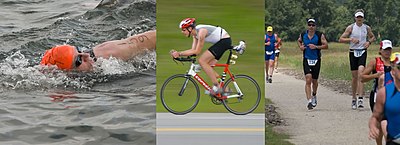
The three typical components of triathlon: swimming, cycling, and running
A triathlon is a multi-sport event involving the completion of three continuous and sequential endurance events.[1] While many variations of the sport exist, triathlon, in its most popular form, involves swimming, cycling, and running in immediate succession over various distances. Triathletes compete for fastest overall course completion time, including timed "transitions" between the individual swim, bike, and run components.[1]
Triathlon races vary in distance. According to the International Triathlon Union, and USA Triathlon, the main international race distances are Sprint distance (750 m swim, 20 km bike, 5 km run), Intermediate (or Standard) distance, commonly referred to as "Olympic distance" (1.5 km swim, 40 km ride, 10 km run), the Long Course (1.9 km swim, 90 km ride, 21.1 km run, such as the Half Ironman), and Ultra Distance (3.8 km swim, 180 km ride, and a marathon: 42.2 km run); the most recognized branded Ultra Distance is the Ironman triathlon.[2]
Transition areas are positioned both between the swim and bike segments (T1), and between the bike and run segments (T2) and are where the switches from swimming to cycling and cycling to running occur. These areas are used to store bicycles, performance apparel, and any other accessories needed for preparing and for the next stage of the race. The time spent in T1 and T2 is included in the overall time of the race.[3] Transitions areas can vary in size depending on the number of participants expected for the race. In addition, these areas provide a social headquarters prior to the race.[4]
The nature of the sport focuses primarily on persistent and often periodized training in each of the three disciplines, as well as combination workouts and general strength conditioning.[5]
[edit] History
Triathlon is considered by some to have its beginnings in 1920s France.[6] According to triathlon historian and author Scott Tinley (and others[7]), the origin of triathlon is attributed to a race during the 1920s–1930s that was called variously "Les trois sports", "La Course des Débrouillards", and "La course des Touche à Tout". This race is held every year in France near Joinville-le-Pont, in Meulan and Poissy.
An earlier tri-sport event in 1902 featured running, cycling, and canoeing.[7] There are documented tri-sport events featuring running, swimming, & cycling (not necessarily in that order) in 1920, 1921, 1945, and the 1960s.[7] In 1920, the French newspaper "L´Auto" reported on a competition called "Les Trois Sports" with a 3 km run, 12 km bike, and a swim across the channel Marne. Those three parts were done without any break. Another event was held in 1921 in Marseilles with the order of events bike-run-swim. Among the participants was American athlete Charles Sector.[8] There are also articles in French newspapers about a race in Marseille in 1927. There is a 1934 article about "Les Trois Sports" (the three sports) in the city of La Rochelle, a race with: (1) a channel crossing (c. 200 m), (2) a bike competition (10 km) around the harbor of La Rochelle and the parc Laleu, and (3) a run (1200 m) in the stadium André-Barbeau.
[edit] Modern triathlon
The first modern swim/bike/run event to be called a 'triathlon' was held at Mission Bay, San Diego, California on September 25, 1974. The race was conceived and directed by Jack Johnstone and Don Shanahan, members of the San Diego Track Club, and was sponsored by the track club. 46 participants entered this event. It was reportedly not inspired by the French events,[9] although a race the following year at Fiesta Island, California, is sometimes called 'the first triathlon in America.'[6]
[edit] Ironman
The first modern long-distance triathlon event was the Hawaiian Ironman Triathlon. It included a swim of 2.4 miles (3.9 km), a bike ride of 112 miles (180 km), and a marathon run of 26.219 miles (42.195 km). It was conceived during the awards ceremony for the 1977 Oahu Perimeter Relay (a running race for 5-person teams).
Among the participants were numerous representatives of both the Mid-Pacific Road Runners and the Waikiki Swim Club, whose members had long been debating which athletes were more fit: runners or swimmers. On this occasion, U.S. Navy Commander John Collins pointed out that a recent article in Sports Illustrated magazine had declared that Eddy Merckx, the great Belgian cyclist, had the highest recorded "maximum oxygen uptake" of any athlete ever measured, so perhaps cyclists were more fit than anyone. Collins and his wife, Judy, had taken part in the triathlons staged in 1974 and 1975 by the San Diego Track Club in and around Mission Bay, California, as well as the Optimist Sports Fiesta Triathlon in Coronado, California, in 1975.
A number of the other military athletes in attendance were also familiar with the San Diego races, so they understood the concept when Collins suggested that the debate should be settled through a race combining the three existing long-distance competitions already on the island: the Waikiki Roughwater Swim 2.4 miles (3.9 km), the Around-Oahu Bike Race (115 miles (185 km); originally a two-day event) and the 42.195 kilometres (26.219 mi)Honolulu Marathon. No one present had ever done the bike race so they did not realize it was a two-day, not one-day, event. Collins calculated that, by shaving 3 miles (4.8 km) off the course and riding counter-clockwise around the island, the bike leg could start at the finish of the Waikiki Rough Water and end at the Aloha Tower, the traditional start of the Honolulu Marathon. Prior to racing, each athlete received three sheets of paper listing a few rules and a course description. Handwritten on the last page was this exhortation:
| “ |
Swim 2.4 miles! Bike 112 miles! Run 26.2 miles! Brag for the rest of your life![10] |
” |
| |
— Commander Collins, USN (1978) |
With a nod to a local runner who was notorious for his demanding workouts, Collins said:
| “ |
Whoever finishes first, we'll call him the Ironman. |
” |
| |
— Commander Collins, USN (1978)[11] |
Of the fifteen men to start off in the early morning on February 18, 1978, twelve completed the race and the world's first Ironman, Gordon Haller, completed it in 11 hours, 46 minutes, and 58 seconds.[11]
[edit] Organizations
Today, a number of triathlon events over varying distances are held around the world. The standard "Olympic Distance" of 1.5/40/10 km (.93/24.8/6.2 miles) was created by long time triathlon race director Jim Curl in the mid-1980s, after he and partner Carl Thomas produced the U.S. Triathlon Series (USTS) between 1982 and 1997.[12] The Hawaii Ironman Triathlon serves as the Ironman World Championship. The entity that owns the race, the World Triathlon Corporation (WTC), hosts other triathlons around the world that also fall under the Ironman brand. Long-distance multi-sport events organized by groups other than the WTC may not officially be called "Ironman" or "Iron" races.[13] Such triathlons may be described as Full distance triathlon or "Half distance", but the "Ironman" and "Iron" labels are the official property of the WTC.
The International Triathlon Union (ITU) was founded in 1989 as the international governing body of the sport, with the chief goal, at that time, to put triathlon on the Olympic program.[14] For its part, the ITU does not sanction WTC races.;[15] however, USAT uses a combination of ITU and WTC rules to sanction WTC's branded events.[16]

The symbol for triathlon in the Olympics
International Ultra-Triathlon Association(IUTA) is the official governing body of Ultratriathlon which involves triathlon in longer distances than Ironman.[17]
[edit] Olympics
The sport made its debut on the Olympic program at the Sydney Games in 2000 over the Olympic Distance (swim: 1,500 m (1,600 yd) – bike: 40 km (24.9 mi) – run: 10 km (6.2 mi)).
[edit] Standard race distances
| Name |
Swim |
Bicycle |
Run |
Notes |
| Kids of Steel |
100–750 m
|
5–15 km
|
1–5 km
|
Distances vary with age of athlete. See: Ironkids |
| Novice (Australia) |
300 m |
8 km |
2 km |
Distances vary, but this is a standard Novice distance course in Australia (often called enticer triathlons). |
| 3–9–3 (New Zealand) |
300 m |
9 km |
3 km |
Distances vary, but this is a standard Novice distance course in New Zealand. |
| Super Sprint |
400 m
(0.25 mi) |
10 km
(6.2 mi) |
2.5 km
(1.5 mi) |
Distances vary, but this is a standard Super Sprint course. |
| Novice (Europe) |
400 m
(0.25 mi) |
20 km
(12.4 mi) |
5 km
(3.1 mi) |
Distances vary somewhat, but this is a standard novice/fitness distance course in Europe. |
| Sprint |
750 m
(0.47 mi) |
20 km
(12.4 mi) |
5 km
(3.1 mi) |
For pool-based races a 400 or 500m swim is common. The sprint distance is the fastest growing triathlon race distance in the United States[citation needed] |
| Olympic |
1.5 km
(0.93 mi) |
40 km
(24.8 mi) |
10 km
(6.2 mi) |
Also known as "international distance", "standard course", or "short course" |
| ITU-Long Distance (O2) |
3.0 km
(1.86 mi) |
80 km
(49.6 mi) |
20 km
(12.4 mi) |
Double Olympic Distance[18] distance of the ITU Long Distance Triathlon World Championships 2007 and 2009. |
| Half |
1.93 km
(1.2 mi) |
90 km
(56 mi) |
21.09 km
(13.1 mi) |
Also known as "middle distance", "70.3" (total miles traveled), or "half-ironman". |
| ITU-Long Distance (O3) |
4.0 km
(2.49 mi) |
120 km
(74.6 mi) |
30 km
(18.6 mi) |
So-called triple Olympic Distance,[18] distance of the ITU Long Distance Triathlon World Championships most years including 2011. |
| Full |
3.86 km
(2.4 mi) |
180 km
(112 mi) |
42.2 km
(26.2 mi) marathon |
Also known as "long distance" or "Ironman Triathlon".[19] |
In addition to the above distances, two new long distance events have appeared, the 111 and 222 events. The 111 distance is 1 km swimming, 100 km bicycling and 10 km running, totalling 111 km (69.0 miles). The 222 distance is double that.[20]
The ITU accepts a 5% margin of error in the cycle and run course distances.[21] Though there can be some variation in race distances, particularly among short triathlons, most triathlons conform to one of those above standards.
The International Triathlon Union (ITU) sanctions and organizes a World Cup series of Olympic distance races each year, culminating in an annual World Championship for both elite pro-triathletes, junior pro-triathletes and amateur athletes in 5-year age-groups. The professional world cup races are conducted in a draft legal format for the bike leg while drafting is not permitted at the amateur level. In addition, the ITU has a Long Distance Triathlon series.
The World Triathlon Corporation (WTC) sanctions and organizes a series of Ironman and Ironman 70.3 distance races each year. These races serve as qualifying events for the World Championships held annually in Kailua-Kona, Hawai'i (October, Ironman) and Clearwater, Florida (November, Ironman 70.3).
Triathlons are not all relegated to these prescribed distances. Distances can be any combination of distance set by race organizers to meet various distance constraints or to attract a certain type of athlete.
[edit] Triathlon overview
Generally, participation in a triathlon requires athletes to register and sign up in advance of the actual race. After registration the racers are provided a race number, colored swim cap, and, if the event is being electronically timed, a timing band. Athletes will either be provided or briefed on details of the course, rules, and any problems to look out for (road conditions, closures, traffic lights, aid stations).[22] At a major event, such as an Ironman or a Long Course Championship, triathletes may be required to set up and check-in their bike in the transition area a day or two prior to the race start, leaving it overnight and under guard.[23]

Transition area (bicycles) of Hamburg Triathlon, 2002
On the race day, prior to the start of competition, athletes will generally be provided with a bike rack to hold their bicycle and a small section of ground space for shoes, clothing, etc. within the transition area. In some triathlons, there are two transition areas, one for the swim/bike change, then one for the bike/run change at a different location. The bicycle stage does not finish in the same place it begins, so athletes set up two transition areas.[24]
Racers are generally categorized into separate professional and amateur categories. Amateurs, who make up the large majority of triathletes, are often referred to as "age groupers" since they are typically further classified by sex and age; which offers the opportunity to compete against others of one's own gender and age group. The age groups are defined in five or ten year intervals.[24] There is typically a lower age limit; which can vary from race to race. In some triathlons, heavier amateur athletes may have the option to compete against others closer to their own weight since weight is often considered an impediment to speed. As an example, under USA Triathlon rules, a "Clydesdale" athlete are those men over 200 pounds, while "Athena" athletes are women over 150 pounds.[25] Other races and organizations can choose whether or not to offer Clydesdale and Athena—type divisions and set their own weight standards.

These runners, at the
Boise Ironman 70.3, had been bicyclists themselves only minutes before.
Depending on the type and size of the race, there may be any of the following methods implemented to start the race. In a mass start, all athletes enter the water and begin the competition following a single start signal. In wave start events, smaller groups of athletes begin the race every few minutes. An athlete's wave is usually determined either by age group or by predicted swim time. Wave starts are more common in shorter races where a large number of amateur athletes are competing.[26] Another option is individual time trial starts, where athletes enter the water one at a time, a few seconds apart[27]
The swim leg usually proceeds around a series of marked buoys before athletes exit the water near the transition area. Racers exit out of the water, enter the transition area, and change from their swim gear and into their cycling gear. Competition and pressure for faster times have led to the development of specialized triathlon clothing that is adequate for both swimming and cycling, allowing many racers to have a transition that consists of only removing their wetsuit and goggles and pulling on a helmet and cycling shoes. In some cases, racers leave their cycling shoes attached to their bicycle pedals and slip their feet into them while riding. Some triathletes don't wear socks, decreasing their time spent in transition even more.
The cycling stage proceeds around a marked course, typically on public roads. In many cases, especially smaller triathlons, roads are not closed to automobiles; however, traffic coordinators are often present to help control traffic. Typically, the cycling stage finishes back at the same transition area. Racers enter the transition area, rack their bicycles, and quickly change into running shoes before heading out for the final stage. The running stage usually ends at a separate finish line near the transition area.
In most races, "aid stations" located on the bike and run courses provide water and energy drinks to the athletes as they pass by. Aid stations at longer events may often provide various types of food as well, including such items as energy bars, energy gels, fruit, cookies, and ice.
Once the triathletes have completed the event, there is typically another aid station for them to get water, fruit, and other post-race refreshments. Occasionally, at the end of larger or longer events, the provided amenities and post-race celebrations may be more elaborate.
[edit] Rules of triathlon
While specific rules for triathlon can vary depending on the governing body (e.g. USA Triathlon, ITU), as well as for an individual race venue, there are some basic universal rules. Traditionally, triathlon is an individual sport and each athlete is competing against the course and the clock for the best time. As such, athletes are not allowed to receive assistance from anyone else inside or outside the race, with the exception of race-sanctioned aid volunteers who distribute food and water on the course.[28][29]
Triathlons are timed in five sequential sections: 1) from the start of the swim to the beginning of the first transition (swim time); 2) from the beginning of the first transition to the end of the first transition (T1 time); 3) from the start of the cycling to the end of the cycling leg (cycling time); 4) from the beginning of the second transition to the end of the second transition (T2 time); 5) and finally from the start of the run to the end of the run, at which time the triathlon is completed.[29] Results are usually posted on official websites and will show for each triathlete his/her swim time; cycle time (with transitions included); run time; and total time. Some races also post transition times separately.
Other rules of triathlon vary from race to race and generally involve descriptions of allowable equipment (for example, wetsuits are allowed in USAT events in the swimming stage of some races when the water temperature is below 79 °F (26 °C),[30] and prohibitions against interference between athletes.[29] Additionally, the use of flippers or other swim propulsion and flotation aids are illegal in triathlon and can result in disqualification.[30]
One important rule involving the cycle leg is that the competitor must be wearing their bike helmet before the competitor mounts the bike and must remain on until the competitor has dismounted; the competitor may remove their helmet at any time as long as they are not on the bicycle (e.g. while repairing a mechanical problem). Failure to comply with this rule will result in disqualification.[29][30] Additionally, while on the bike course, all bicycles shall be propelled only by human force and human power. Other than pushing a bicycle, any propulsive action brought on by use of the hands is prohibited. Should a competitor's bike malfunction they can proceed with the race as long as they are doing so with their bicycle in tow.[30]
[edit] Triathlon and fitness

Triathletes competing in the swim component of race. Wetsuits are common but not universal
Participants in triathlon often use the sport to improve or maintain their physical fitness.[31][32] With each sport being an endurance event, training for a triathlon provides cardiovascular exercise benefits.[33] Additionally, triathletes encounter fewer injuries than those who only use running as part of their exercise routine due to the incorporation of low impact swim and bike training.[34]
Athletes who participate in endurance events spend many hours training for those events and this is true for triathlon as well.[35] Injuries that are incurred from long hours of a single activity are not as common in triathlon as they are in single sport events. The cross-training effect that athletes achieve from training for one sport by doing a second activity applies to triathlon training.[34] Additional activities that triathletes perform for cross-training benefits are yoga, pilates, and weight training.[36]
[edit] Swimming
Triathletes will often use their legs less vigorously and more carefully than other swimmers, conserving their leg muscles for the cycle and run to follow. Many triathletes use altered swim strokes to compensate for turbulent, aerated water and to conserve energy for a long swim. In addition, the majority of triathlons involve open-water (outdoor) swim stages, rather than pools with lane markers. As a result, triathletes in the swim stage must jockey for position, and can gain some advantage by drafting, following a competitor closely to swim in their slipstream. Triathletes will often use "dolphin kicking" and diving to make headway against waves, and body surfing to use a wave's energy for a bit of speed at the end of the swim stage. Also, open-water swims necessitate "sighting": raising the head to look for landmarks or buoys that mark the course. A modified stroke allows the triathlete to lift the head above water to sight without interrupting the swim or wasting energy.
Because open water swim areas are often cold and because wearing a wetsuit provides a competitive advantage, specialized triathlon wetsuits have been developed in a variety of styles to match the conditions of the water. For example, wetsuits that are sleeveless and cut above the knee are designed for warmer waters, while still providing buoyancy. Wetsuits are legal in sanctioned events at which the surface water temperature is 78 °F (26 °C) or less.[30] In non-sanctioned events or in "age group" classes where most racers are simply participating for the enjoyment of the sport instead of vying for official USA Triathlon placing, wetsuits can often be used at other temperatures. Race directors will sometimes discourage or ban wetsuits if the water temperature is above 84 degrees due to overheating that can occur while wearing a wetsuit.[37] Other rules have been implemented by race organizers regarding both wetsuit thickness as well as the use of "swim skins;" which need to be considered by those participating in future triathlons.
[edit] Cycling

Triathlete in the cycling portion of the event.
Triathlon cycling can differ from most professional bicycle racing depending on whether drafting is allowed during competition. In some competitions, like those governed by USA Triathlon and the World Triathlon Corporation, drafting is not allowed,[30] the cycling portion more closely resembles individual time trial racing. In other races, such as those in World Cup and Championship racing, drafting and the formation of pelotons are legal.[1][29] This places an emphasis on running performance as several athletes will enter the bike to run transition at the same time due to drafting.[38]
Triathlon bicycles are generally optimized for aerodynamics, having special handlebars called aero-bars or tri-bars, aerodynamic wheels, and other components. Triathlon bikes use a specialized geometry, including a steep seat-tube angle both to improve aerodynamics and to spare muscle groups needed for running (see also triathlon equipment). At the end of the bike segment, triathletes also often cycle with a higher cadence (revolutions per minute), which serves in part to keep the muscles loose and flexible for running. It is believed, though, that the primary benefit to cycling in a triathlon is that the strain of the effort is placed disproportionately on the slow-twitch muscle fibers, preventing the athlete from accumulating an oxygen debt before the run.
[edit] Running

A wheelchair-bound athlete competes amongst runners at Ironman 70.3 on the
Boise Greenbelt.
The primary distinguishing feature of running in a triathlon is that it occurs after the athlete has already been exercising in two other disciplines for an extended period of time, so many muscles are already tired. The effect of switching from cycling to running can be profound; first-time triathletes are often astonished at their muscle weakness, maybe caused by lactate accumulation and the bizarre, sometimes painful sensation in their thighs a few hundred yards into the run, and discover that they run at a much slower pace than they are accustomed to in training. Triathletes train for this phenomenon through transition workouts known as "bricks": back-to-back workouts involving two disciplines, most commonly cycling and running.
[edit] Well-known events
Thousands of individual triathlons are held around the world each year. A few of these races are well known because they have a long history or because they have particularly grueling courses and race conditions. A few are listed here.
- Hawaii Ironman World Championship, Kona, Hawaii. First held in 1978 on Oahu, only five years after the sport of triathlon was founded; it was later moved to Kailua-Kona on the island of Hawaii. The cycling stage of the race covers more than a hundred miles over lava flats on the big island of Hawaii, where mid-day temperatures often reach over 110 °F (43 °C) and cross-winds sometimes blow at 55 MPH (90 km/h). The race is often challenging even to competitors with experience in other iron-distance events.
- Nice Triathlon, Nice, France. A race that existed until 2002 when the course was adopted by the WTC as Ironman France. During the 1980s the Nice Long Distance triathlon (Swim 4 km, Bike 120 km, Run 30 km) was, alongside the World Championships in Kona, one of the two important races each year with prize money and media attention. Mark Allen won here 10 consecutive times. The ITU's Long Distance is a Nice-Distance race except a short period from late 2006 to early 2008, in which it was 3 km + 80 km + 20 km.
- Enduroman Arch to Arc. A 289-mile triathlon from Marble Arch, London to the Arc de Triomphe, Paris. Run from Marble Arch in London to Dover (87 miles), swim the English Channel (22 miles) to Calais, and then cycle 181 Miles from Calais to Paris. For this challenge, the clock starts at Marble Arch and stops at Arc de Triomphe. Only 7 people in history have completed this event and the current record is held by Eddie Ette with a time of 81 hours and 5 minutes.
- St. Anthony's, St. Petersburg, Florida. The unofficial season opener for the triathlon year. Held in the last week of April every year, this race attracts professional and amateur triathletes from around the world. One of the largest Olympic Distance triathlon in the U.S. with over 4000 participants each year.
- Escape from Alcatraz, San Francisco, California. This non-standard-length race begins with a 1.5-mile (2.4-km) swim in frigid San Francisco Bay waters from Alcatraz Island to shore, followed by an 18-mile (29-km) bicycle and 8 mile (13 km) run in the extremely hilly terrain of the San Francisco Bay area. The run includes the notorious "Sand Ladder", a 400-step staircase climb up a beachside cliff.
- Wildflower is a Half-Ironman distance race held on or near May 1 at Lake San Antonio in Northern California since 1983. In recent years it has become a highlight on the race-calendar of many professional triathletes. Known for a particularly hilly course, it has expanded now to include three races of different lengths and is one of the largest triathlon events in the world, with over 8,000 athletes attending each year.
- Life Time Fitness Triathlon Series, a series of 5 Olympic distance races: The Lifetime Fitness in Minneapolis, the NYC Triathlon in New York City, the Chicago Triathlon, the LA Triathlon in Los Angeles, and the U.S. Open in Dallas. There is a combined $1.5 Million prize purse at stake for the professionals who come from around the world to take part in the series.
- Hy-Vee Triathlon, started in 2007 by the Mid-West grocery store chain. Famous for the richest prize purse ever awarded at a single triathlon ($700,000). Part of the draft-legal ITU World Cup circuit and the only one on USA soil in '07 & '08. Also hosts a sold-out age group race, youth races, and a Junior Development race. Given the honorable distinction of the third and final USA Triathlon Olympic Trials event in 2008.
- Norseman Extreme Triathlon, Hardangerfjord, Norway. Norseman is an Ironman-distance triathlon that starts with a swim in the Hardangerfjord and finishes on top of a Gaustatoppen mountain at 1,850 meters above sea level. Famous for its lower temperatures and 5,000 meters total ascent, this race accepts only 200 competitors each year.
- Ironman 70.3 World Championship, Clearwater, Florida, USA. Since 2006 this has been the final of the Ironman 70.3 series on the half Ironman distance.
- Grand Prix de Triathlon, the French club championship series sponsored by Lyonnaise des Eaux. The circuit comprises five triathlons and by the French Triathlon Federation it is considered the most prestigious French championship. It is of international importance because most of the participants are international, i.e. non French elite top stars hired pro forma by the best French clubs.
- Triathlon EDF Alpe d'Huez, established in 2006 by the 2002 Long Distance World Champion Cyrille Neveu, is one of the best known single triathlons in France.
[edit] Nonstandard variations
- Aquabike, composed of only swimming and cycling stages.
- Aquathlon, composed of only swimming and running stages.
- Duathlon, composed of only cycling and running stages.
- Equilateral triathlon, a triathlon in which each leg takes approximately equal time.
- Formula One triathlon, an event that consists of a swim-bike-run combination in multiple groups.
- Indoor triathlon, consisting of a pool swim, stationary bike, and indoor track or treadmill run.
- Nauticathlon TM, Trademark, owner Victor Bauduret / France Composed of many sports (rules http://www.nauticathlon.com)
- Off-road triathlon, consists of swimming, mountain biking and trail running. The best-known series of these races is known as the XTERRA Triathlon.
- Pedal, Paddle, Run, consisting of a bike, kayak, and run.
- Ultraman triathlon, an Ultra-long distance three day triathlon covering 320 miles in separate stages.
- Winter triathlon, typically includes two events of either cross-country skiing, mountain biking or outdoor-ice speed skating and finishes with running.


 لباس یک سه گانه کار
 سه گانه کاران خارجی
 این وبلاگ در نظر دارد
Responses to "WADA sets out its strategic plan for the next five years"